
Oct 20, 2026 · @Shannon McCraw
Your business can sit on page one of Google and still be invisible to the customer who asks ChatGPT for a recommendation. That gap is what AI search visibility is about, and most local owners have no idea where they stand.
I’m Shannon McCraw, founder of Virtual Surge, an SEO and AI search agency serving Baltimore and businesses across Maryland. For more than ten years, I’ve helped dentists, orthodontists, law firms, and home service companies get found online.
Lately, though, the question I hear most has changed. Owners used to ask how to rank higher. Now they ask, “Why did a new patient tell me ChatGPT recommended the practice down the street?”
This post answers that question. You’ll see how AI tools decide which businesses to name, why strong Google rankings don’t carry over on their own, and what you can do about it starting this week.
How Your Customers Are Searching Now
People don’t type “dentist Towson” the way they did a few years ago. Instead, they ask full questions, the same way they’d ask a friend.
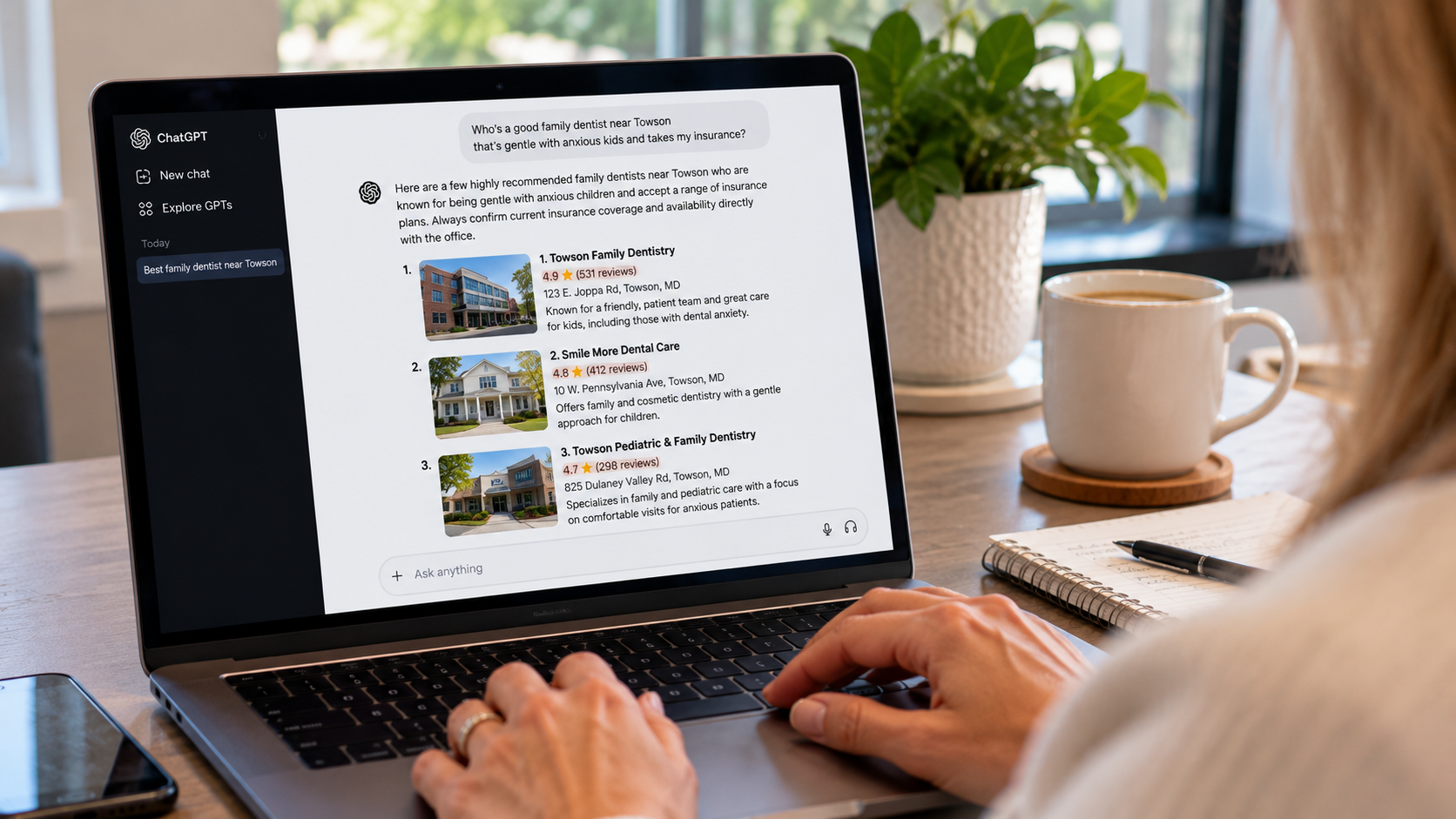
A typical one sounds like this: “Who’s a good family dentist near Towson that’s gentle with anxious kids and takes my insurance?” That question no longer goes only to Google. It goes to a handful of AI tools:
- ChatGPT, which can search the web and name specific businesses
- Perplexity, which answers with a short list and cites its sources
- Google AI Overviews, the summary that now appears above the regular results
- Gemini, Google’s assistant, built into phones and Chrome
Here’s the part that matters most. A Google results page shows ten options, and a shopper might scroll through several. An AI answer usually names two or three businesses and stops.
So if you aren’t named, you aren’t in the running. The customer never sees a list long enough to find you.
Why Ranking on Google Doesn’t Guarantee AI Mentions
Google ranks individual web pages. AI tools work differently, because they build an answer by pulling together what many sources say about you. Before an AI names your business, it needs to feel confident you’re a safe recommendation.
That confidence comes from places your SEO may never have touched. Here’s where the gap usually opens up.
- AI reads far beyond your website. It checks directories, review sites, local news, industry lists, and community forums like Reddit.
- Your site may sell without explaining. Pages full of “quality care” and “trusted service” give an AI nothing concrete to repeat.
- Mixed signals erode trust. An old phone number on one directory and a different suite number on another make your business look less certain.
- Each tool has its own sources. You can appear in Perplexity and be missing from ChatGPT, so checking one platform tells you very little.
None of this means your SEO was wasted. Strong rankings, a healthy Google Business Profile, and good content are the foundation. AI search visibility simply asks for more on top of that foundation.
What AI Tools Look For Before Recommending a Business
No AI company publishes its exact recipe. Still, after running these checks for clients across several industries, I see the same signals show up again and again.
Consistent Business Information Everywhere
Your name, address, phone number, hours, and services should match on every site that lists you. That includes Google, Bing, Apple Maps, Yelp, Facebook, and the directories in your industry. Consistency tells an AI it’s looking at one real, stable business.
Reviews That Say Something Specific
Star ratings help, but the words inside reviews matter even more. A review that mentions “Invisalign,” “weekend appointments,” and “great with nervous patients” connects you to those exact questions. Five stars with “Great job!” gives an AI very little to work with.
Clear Answers on Your Own Website
AI tools love pages that answer questions plainly. Spell out which services you offer, which towns you serve, what a first visit looks like, and roughly what people can expect to pay. A solid FAQ section on each service page is one of the simplest wins available.
Mentions on Sites AI Already Trusts
Think local news coverage, chamber of commerce listings, professional associations, and “best of” roundups. When respected sources mention you, AI tools treat that as outside proof that you’re legitimate.
Structured Data That Spells Out Who You Are
Schema markup is code that labels your business details in a format machines read easily. Visitors never see it. For AI systems, however, it removes guesswork about what you do and where you do it.
Mistakes I See All the Time
Most businesses that struggle with AI search aren’t doing anything wrong on purpose. They’re simply running a playbook built for an older version of the internet.
Here’s one that still surprises me. A dental office will invest in a beautiful new website, yet three directory sites still list a hygienist who left years ago and an old Saturday schedule. Nobody on staff knows those listings exist. The AI tools know, though.
Other patterns come up constantly:
- Treating AI search as a fad. Your customers have already changed how they search, whether or not your marketing has caught up.
- Letting the Google Business Profile go stale. Outdated services, missing photos, and unanswered questions all weaken your signals.
- Writing service pages that only list services. A bullet that says “dental implants” answers nothing a patient actually wants to know.
- Ignoring what reviews actually say. Owners chase review counts and never guide happy customers to describe the specific service they received.
- Buying tools that promise instant AI rankings. No honest provider can guarantee a mention in ChatGPT next week.
What This Looks Like by Industry
Dental and orthodontic practices often lose out on specific treatment questions, like Invisalign for adults or sedation options. Law firms tend to be invisible for plain language questions, such as “Do I need a lawyer after a minor car accident in Maryland?” Home service companies usually suffer most from inconsistent listings, especially when they’ve changed phone numbers or service areas.
A Quick Self Check You Can Run Today
You don’t need special software to get a first read on your AI search visibility. Set aside about 20 minutes and try this.
- Open ChatGPT, Perplexity, and Gemini. Use a private browser window so your search history doesn’t skew the answers.
- Ask the question your best customer would ask. Include your town, for example: “Who’s the best personal injury lawyer in Bel Air, MD?”
- Write down who gets named. Also note any websites the AI cites, since those sources shape its answer.
- Ask about your business directly. Try “What do you know about [Your Business] in [Your City]?” and check every detail for accuracy.
- Search the same question on Google. See whether an AI Overview appears and whether you’re in it.
- Repeat with four or five variations. Change the service, the neighborhood, or the customer’s main concern.
When you’re done, you’ll have a rough scorecard. If competitors keep showing up and you don’t, that’s a clear signal. And if an AI gets your hours, location, or services wrong, fix that first.
What a Virtual Surge AI Visibility Audit Covers
The self-check shows you whether there’s a problem. An audit shows you why, and exactly what to fix first.
When I run an AI visibility audit, I look at your business the way an AI tool does. That means going well past your website. Every audit includes:
- Prompt testing across four platforms: ChatGPT, Perplexity, Gemini, and Google AI Overviews, using the questions your real customers ask
- A competitor comparison: who gets recommended instead of you, and what they have that you don’t
- Source mapping: the specific websites AI tools cite in your market, so you know where to earn mentions
- Listings and review analysis: inconsistent details, stale profiles, and gaps in what customers say about you
- A website check: how clearly your pages answer questions, plus your schema markup
- A prioritized action plan: written in plain English, ranked by impact, so you know what to do Monday morning
Because my background is traditional SEO, the plan never trades your Google rankings for AI mentions. The goal is to strengthen both at the same time.
Frequently Asked Questions
What is AI search visibility?
AI search visibility is how often, and how accurately, AI tools like ChatGPT, Perplexity, Gemini, and Google AI Overviews mention your business. It covers whether you get recommended and whether the details they share are correct. You may also hear it called GEO (generative engine optimization) or AEO (answer engine optimization).
Is AI search replacing Google?
Not entirely, and Google itself now shows AI answers at the top of many searches. Your customers are spreading their searches across more tools. The smart move is to stay strong on Google while making sure AI platforms can find and trust you too.
How long does it take to start showing up in AI recommendations?
It depends on your starting point and your competition. Fixing wrong information can help within weeks once the AI tools pick up the corrections. Building the reviews, mentions, and content that earn steady recommendations usually takes several months of consistent work.
Do I still need traditional SEO?
Yes. Many AI tools pull from search engine results and from the same trusted websites that support your Google rankings. Strong SEO is the foundation that AI search visibility is built on.
Which AI tools matter most for a local business?
ChatGPT, Google AI Overviews, Perplexity, and Gemini are the four worth watching right now. Each one uses its own mix of sources, so you can do well on one and be missing from another. That’s why an audit tests all four instead of just one.
Find Out What AI Is Saying About Your Business
Right now, an AI tool is answering questions about your industry in your town. It’s either naming you or naming someone else.
The good news is that this is fixable, and early movers have a real edge. Book a consultation with Virtual Surge, and I’ll show you where you stand across ChatGPT, Perplexity, Gemini, and Google, plus what to fix first. Whether you’re in Baltimore, elsewhere in Maryland, or anywhere in the U.S., let’s make sure your customers hear your name.